
This is probably the first time Rahul Gandhi is attending this committee's meeting since being nominated to the panel last year after Lok Sabha elections.

The structure and the level at which the hotline would be set up is likely to come up for discussion in future meetings between the two countries at the military level, they said.

Northern Army commander Lieutenant General Upendra Dwivedi on Friday said the situation along the Line of Actual Control in eastern Ladakh was stable but in a state of "heightened alert" and asserted that there would be no security lapse on fronts of "operational preparedness and readiness" along the India-China border.

'I want to assure this House that in these talks we have not conceded anything.' Full text of what Defence Minister Rajnath Singh told Parliament on the Chinese pullback in eastern Ladakh.

India has already mobilised fighter jets and sent thousands of additional army troops to forward locations along the border with China after 20 Indian Army personnel were killed in a brutal attack by Chinese troops in eastern Ladakh's Galwan Valley on June 15.
Negotiations are underway to have a "more practical and effective" mechanism to prevent face-offs between Indian and Chinese troops on the Line of Actual Control and efforts are being made to have confidence building measures, Defence Minister A K Antony said on Monday.
'They also agreed that for the overall development of bilateral relations it was essential to maintain enduring peace and tranquillity in the border areas,' the MEA said in a statement.

Chinese Foreign Minister Wang Yi arrived in India Thursday evening in the highest-level visit between the two countries after the ties came under severe strain following the eastern Ladakh standoff nearly two years ago.

External Affairs Ministry Spokesperson Anurag Srivastava said China's claim over Galwan Valley was not in accordance with its own position in the past, noting that attempts of transgression by Chinese side were invariably met with appropriate response from the Indian troops.
It also noted that under the leadership of Prime Minister Narendra Modi, India is more likely than in the past to respond with military force to Pakistani provocations.
The Indian side also told the Chinese delegation that the talks on disengagement should include Depsang as well as all face-off sites, insisting that it should be a simultaneous process and not a selective one.

This is the first time that the defence ministry has admitted officially about the transgressions by the Chinese troops.

After the disengagement process is completed, the two armies are likely to hold further talks to take the process further.

The use of firearms along the LAC marks a serious escalation in border tensions as the previous instance of shots being fired at the de-facto border was in 1975.
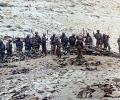
'The Galwan Valley clashes helped us prioritise our national security approach towards the northern border'
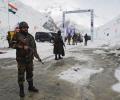
External affairs ministry spokesperson Arindam Bagchi said it is essential that "appropriate agreements between India and China of 1993 and 1996 are scrupulously followed".
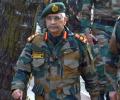
Chief of Army Staff Gen MM Naravane on Friday visited several forward areas in eastern Ladakh and carried out a comprehensive review of India's operational preparedness in the backdrop of its prolonged military standoff with China in the mountainous region.

India on Thursday said it keeps a constant watch on all developments having bearing on national security, three days after new satellite images indicated the construction of a Chinese village east of the Doklam plateau on the Bhutanese side.

'He is psychologically preparing the PLA and the Chinese public to avoid a loss of face.'
During their hour-long in-person meeting on the sidelines of a Shanghai Cooperation Organisation (SCO) conclave in Dushanbe on Wednesday, External Affairs Minister S Jaishankar also told his Chinese counterpart and State Councilor Wang Yi that any unilateral change in the status quo along the Line of Actual Control (LAC) was 'not acceptable' to India and that the overall ties can only develop after full restoration of peace and tranquillity in eastern Ladakh.
The Chinese military has already completed moving back its troops from the face-off sites in Galwan Valley, Gogra and Hot Springs in line with the first phase of the disengagement process from the friction points on the LAC in eastern Ladakh, sources said. The main focus now shifts to Pangong Tso. India has been insisting that China must withdraw its forces from areas between Finger Four and Eight.
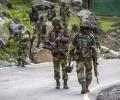
The sources said there was clear sign of withdrawal of structures and troops from the patrolling point 14 in Galwan Valley and that they are likely to move back more than a kilometre in the area.

In a major boost to its fire power, the Indian Army has deployed a sizeable number of upgraded L70 anti-aircraft guns in the high mountains along the Line of Actual Control in Arunachal Pradesh in addition to its existing M-777 howitzers and Swedish Bofors guns, officials said on Wednesday.

'There is a sense of realism in the Pakistan army that if they needled India during the Ladakh standoff, they would have seen a strong retaliation.' 'Pakistan was hoping that India would come out looking weaker in the region and get embarrassed, but that obviously has not happened.'
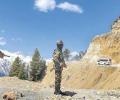
People familiar with the development said Chief of Army Staff General M M Naravane and the top commanders will review the country's combat readiness in eastern Ladakh where Indian and Chinese troops have been locked in a bitter standoff for 17 months.

Chinese Foreign Minister Qin Gang will travel to India to attend the meeting of G20 foreign ministers on March 2, during which he is expected to hold his first bilateral meeting with External Affairs Minister S Jaishankar.

'It has been doing yeoman service for the people of the North East.'

'China is unwilling to restore the status quo ante of April 2020.' 'India will have to weigh its options based on this premise.'
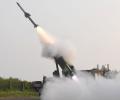
'China is in the middle of a substantial expansion of its nuclear weapon arsenal, which satellite images indicate includes the construction of over 300 new missile silos,' SIPRI's statement noted.

Senior commanders of the two armies held intense negotiations for nearly 11 hours on Sunday at a designated meeting point in Moldo on the Chinese side of the Line of Actual Control.

Replying to clarifications sought by MPs in Rajya Sabha on his statement on the border row, the minister said skirmishes and face-off with China in the last few months have been primarily over the issue of patrolling the Ladakh border.
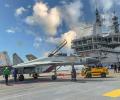
New Delhi's regional partners in restraining a belligerent China -- primarily the US, Japan, Australia and Singapore -- would like the Indian Navy to lock down the Indian Ocean Region, while the other partners can focus on deterring the PLA (navy) in the South China Sea, explains Ajai Shukla.

Army chief General Naravane said the ongoing dialogue will sort out all the perceived differences between the two countries.

The MEA spokesperson further said the actions and behaviour of the Chinese side since earlier this year along the LAC have been in "clear violation" of the bilateral agreements and protocols concluded between the two countries to ensure peace and tranquility on the border.
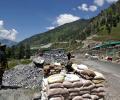
India's top military and strategic brass on Tuesday reviewed the overall situation in eastern Ladakh amid indications that the latest round of talks between senior military commanders of Indian and Chinese armies on the next phase of disengagement of troops may not have produced encouraging results, people familiar with the developments said.

Once again an Indian prime minister has realised that with Pakistan and China, things will not move as he wishes.

'They will try more rounds of military level talks and move it to the diplomatic and political domain to see if there is a possibility of a solution -- and like the CDS said if that does not happen, we are prepared.'
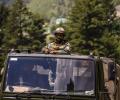
'Our biggest advantage is that the troops are much better trained and motivated than the Chinese and can improvise and manage with a part of the resources.'
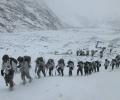
The comments by External Affairs Ministry Spokesperson Anurag Srivastava came at a media briefing when asked about the fresh comments by the Chinese foreign ministry blaming India again for the border situation in eastern Ladakh.
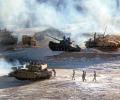
'India cannot allow Beijing's policy of stabilising and destabilising the border at will to perpetuate its own ends.' A riveting excerpt from Manish Tiwari's 10 Flashpoints; 20 Years National Security Situations That Impacted India.
